Table Of Content
Suppose that there are a treatments (factor levels) and b blocks. In some disciplines, each block is called an experiment (because a copy of the entire experiment is in the block) but in statistics, we call the block to be a replicate. This is a matter of scientific jargon, the design and analysis of the study is an RCBD in both cases. Another way to think about this is that a complete replicate of the basic experiment is conducted in each block. In this case, a block represents an experimental-wide restriction on randomization. Many industrial and human subjects experiments involve blocking, or when they do not, probably should in order to reduce the unexplained variation.
Gutenberg 15.6 Introduces Experimental Details Block and Command Center for Site Editor - WP Tavern
Gutenberg 15.6 Introduces Experimental Details Block and Command Center for Site Editor.
Posted: Thu, 20 Apr 2023 07:00:00 GMT [source]
Assign treatments to blocks
Because of the restricted layout, one observation per treatment in each row and column, the model is orthogonal. When the data are complete this analysis from GLM is correct and equivalent to the results from the two-way command in Minitab. What if the missing data point were from a very high measuring block?
Why is the randomized controlled double-blind experiment ideal?
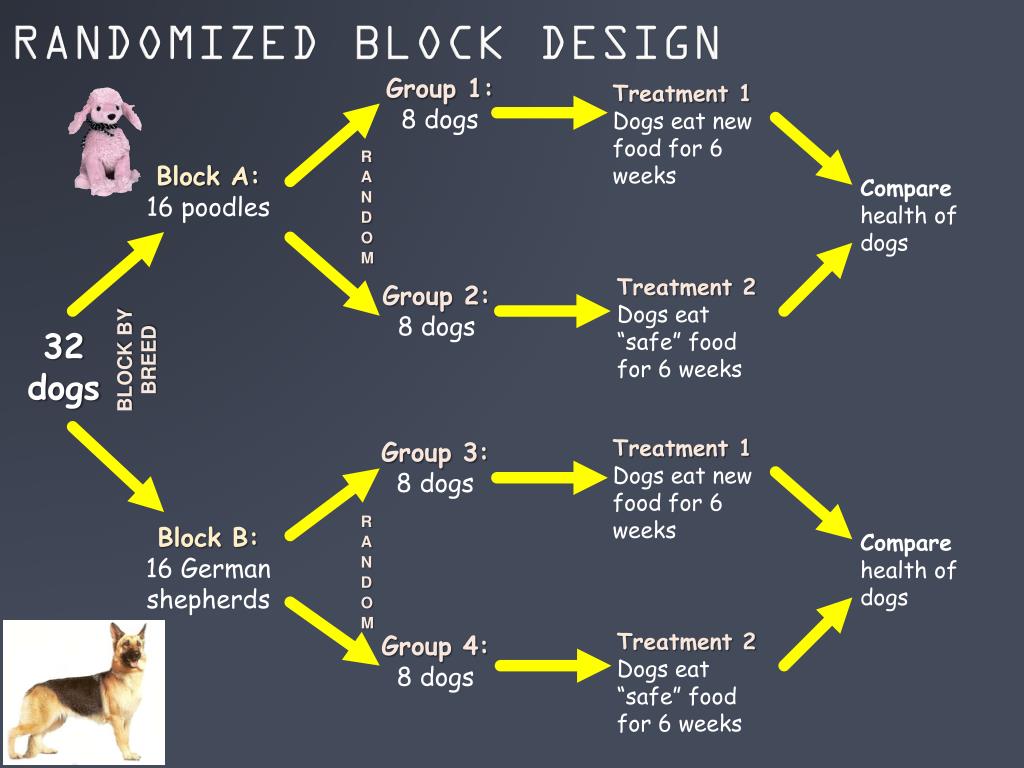
The fact that you are replicating Latin Squares does allow you to estimate some interactions that you can't estimate from a single Latin Square. If we added a treatment by factory interaction term, for instance, this would be a meaningful term in the model, and would inform the researcher whether the same protocol is best (or not) for all the factories. At a high level, blocking is used when you are designing a randomized experiment to determine how one or more treatments affect a given outcome. More specifically, blocking is used when you have one or more key variables that you need to ensure are similarly distributed within your different treatment groups. Combining the two species, 32 ± 4.7% of the papers were judged to have been designed and randomised to an acceptable standard, although none of them stated that they had used either the CR or RB design. Scientists wishing to build repeatability into their experiments could use the RB design, spreading the blocks over a period of time.
AP Statistics:Table of Contents
When all treatments appear at least once in each block, we have a completely randomized block design. Latin Square Designs are probably not used as much as they should be - they are very efficient designs. In other words, these designs are used to simultaneously control (or eliminate) two sources of nuisance variability. For instance, if you had a plot of land the fertility of this land might change in both directions, North -- South and East -- West due to soil or moisture gradients. As we shall see, Latin squares can be used as much as the RCBD in industrial experimentation as well as other experiments.
Limitations of the randomized block design
Physics study of block/prismatic-type HTGR design option for the Indonesian Experimental Power Reactor (RDE) - ScienceDirect.com
Physics study of block/prismatic-type HTGR design option for the Indonesian Experimental Power Reactor (RDE).
Posted: Fri, 04 Sep 2020 02:25:15 GMT [source]
There are times where imputation is still helpful but in the case of a two-way or multiway ANOVA we generally will use the General Linear Model (GLM) and use the full and reduced model approach to do the appropriate test. After calculating x, you could substitute the estimated data point and repeat your analysis. So you can analyze the resulting data, but now should reduce your error degrees of freedom by one. In any event, these are all approximate methods, i.e., using the best fitting or imputed point.
A Case 3 approach involves estimating separate period effects within each square. Let's take a look at how this is implemented in Minitab using GLM. Use the viewlet below to walk through an initial analysis of the data (cow_diets.mwx | cow_diets.csv) for this experiment with cow diets. The following crossover design, is based on two orthogonal Latin squares. To achieve replicates, this design could be replicated several times. This situation can be represented as a set of 5, 2 × 2 Latin squares.
It’s likely that the gender of an individual will effect the amount of weight they’ll lose, regardless of whether the new diet works or not. Unfortunately nuisance variables often arise in experimental studies, which are variables that effect the relationship between the explanatory and response variable but are of no interest to researchers. Blocking first, then randomizing ensures that the treatment and control group are balanced with regard to the variables blocked on.
Table of Contents
The sequential sums of squares (Seq SS) for block is not the same as the Adj SS. Is the period effect in the first square the same as the period effect in the second square? If it only means order and all the cows start lactating at the same time it might mean the same. But if some of the cows are done in the spring and others are done in the fall or summer, then the period effect has more meaning than simply the order. Although this represents order it may also involve other effects you need to be aware of this.
7 - Incomplete Block Designs
First we discuss what blocking is and what its main benefits are. After that, we discuss when you should use blocking in your experimental design. Finally, we walk through the steps that you need to take in order to implement blocking in your own experimental design. \(\rightarrow\) This reduces the variance of the residuals and leads to a power gain if the variability between mice/blocks is large.
A survey of 100 papers involving mice and rats was used to determine whether scientists had used the CR or RB designs. The papers were assigned to three categories “Design acceptable”, “Randomised to treatment groups”, so of doubtful validity, or “Room for improvement”. Only 32 ± 4.7% of the papers fell into the first group, although none of them actually named either the CR or RB design. A randomized block design is an experimental design where the experimental units are in groups called blocks. The treatments are randomly allocated to the experimental units inside each block.
This subset of columns from the whole Latin Square creates a BIBD. This is a Case 2 where the column factor, the cows are nested within the square, but the row factor, period, is the same across squares. In this Latin Square we have each treatment occurring in each period. Even though Latin Square guarantees that treatment A occurs once in the first, second and third period, we don't have all sequences represented. It is important to have all sequences represented when doing clinical trials with drugs.




No comments:
Post a Comment